Saturday, 19 April 2014

Front hub seal replacement

During the 2nd A service a couple of weeks ago, the front axle oil was found to be contaminated by one shot grease from the front hubs. There is a seal in the swivel ball housing that separates these lubricants. Since it wasn't possible to tell which hub was causing the problem, both hubs would need to be rebuilt.
There are some good video tutorials covering this job and I would particularly recommend watching Land Rover Front Axle Overhaul Tutorials on the Land Rover Toolbox YouTube channel if you are planning to do this job.

As the job requires the hubs to be completely stripped down, the various other seals and gaskets were bought along with new axle oil and swivel ball grease.


To get to the seal, the hub was stripped down starting with the circlip on the end of the driveshaft

Befor getting to deep into the job, the ABS sensor was removed to ensure that it did not get damaged.

The steering arms were disconnected. The Land Rover Toolbox channel has a great tip for this job - shown in this video
 
 
The brake caliper was removed and secured to the radius arm using a cable tie. During disassembly of the first side, the brake dust guard was removed. However this is not neccessary and the job can be done without removing it.

After removing the drive member, the hub nut was removed using a 52mm socket.
The hub was pulled off the stub axle.
Removing the stub axle allowed the drive shaft to be withdrawn.
 

A painted garage floor makes a great alternative to a white board for organising all the bits as they come off
 

The swivel ball was removed using a very long 14mm ring spanner. The threadlock makes the bolts tight all the way.(Having done this job I've bought a set of extra long ratchet spanners that should make the job easier in future).


 The old seal was removed but looked to be in very good condition, the swivel ball was cleaned up and a new seal fitted.


 TIP: The old hub nut was used to help hammer the new seal in flat


TIP:Before refitting the swivel ball, the threads in the axle flange were tapped out to remove the old thread sealer. This is highly recommended as it makes the reassembly process much easier.
 
A new swivel ball gasket was fitted before reassembly
 
TIP: When reassmbling the swivel ball seal and retaining ring can be moved over the axle to get them out of the way. I only learnt this when I was doing the second side.
 
The bolts for the swivel ball had high strength threadlock applied and were tighten by feel because the torque wrench cannot reach the bolt heads 
 
 After reassembling the swivel ball housing, the to bearing was shimmed until the force required to move the hubs was between 1.1 to 1.4kg.
 
 
After reshimming, the swivel ball seal and seal retainer were fitted with the 8mm bolts being torqued to 11Nm. 
 

The halfshaft was refitted...

....followed by the stub axle. The stub axle bolts had high strength thread lock applied before being tightened to a torque of 65Nm.


At this point the swivel ball was filled with the one shot grease.
 
 
Before refitting the wheel hub, the old seal was removed and replaced. The wheel bearings were also greased:


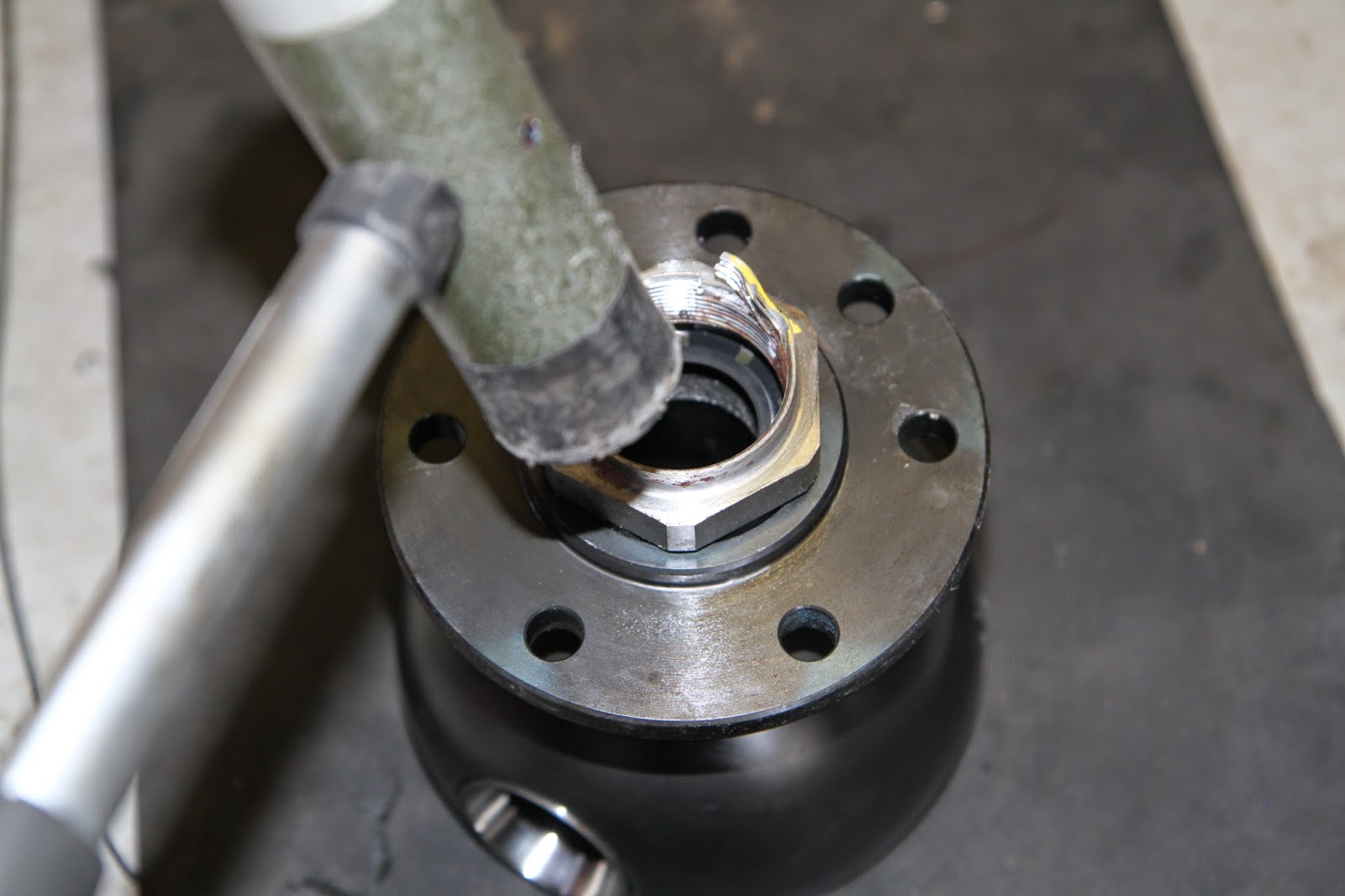
The wheel hub assembly was refitted and the new hub nut was tightened to a torque of 130Nm 
 
The hub nut was deformed around the flat on the stub axle using a flat cold chisel .
 
A fresh gasket was applied to the drive member
 
TIP: For all the threadlocked bolt, use a die to cut the old threadlock out of the threads. 
 
 
The drive member bolts were applied with the high strength thread lock and tightened to 65Nm
 
 The steering arm ends were torqued up to 40Nm and new split pins were fitted.


Before refitting the brake caliper, copper grease was applied to the wheel nut studs.

 
The brake caliper was refitted...

...followed by the road wheel.


Friday, 4 April 2014

2nd "A" Service

The Defender was taken to Beyond Performance 4x4 today for it's 2nd A service. After enquiring about the make of oil used for the service, I decided to provide Castrol Magnatec 5w-30. The guys were more than happy to use this.

The service appears to have been carried out very thoroughly with 2 issues being reported:
  1. The oil in the transfer case was a bit low. This was topped up to the correct level.
  2. The oil in the front axle was contaminated with one shot grease from the front hubs. The axle oil was drained and replaced as a temporary measure until the front hubs could be rebuilt.


Sunday, 16 March 2014

Lights on warning buzzer

 
Another feature that sets the Land Rover Defender apart from normal cars is visual "lights on warning system" comprising of 4 warning lights, one positioned on each corner of the car. Normal cars often employ an audible warning system but this cannot be heard from outside the car.
The weakness of the Defenders system is that you need to be facing the car to see the warning lights.
The TDCI defender has a separate switched ground for the drivers door feeding into the ECU and a warning buzzer integrated into the instrument cluster (used for low fuel warning), so it seems Land Rover have made a design decision not to use an audible warning.

In order to augment the Defender system, a buzzer is added here so that both visual and audible warnings can be observed.

The warning buzzer used was sourced from Polevolt. It uses the feed to the side light circuit for power and is grounded through the drivers door switch. The feed from the ignition is used to disable the buzzer so it doesn't sound when the ignition is on.  
 
The first job was to take a feed from the door switch into the dash where the buzzer will be sited. It is difficult to access the point where the loom enters the bulkhead, so a (yellow/red) draw wire was pushed down the existing loom and fished out of the hole where the door loom connects into the bulkhead. A 2mm.sq wire was used as the draw wire as it's stiffness made it easier to push through the loom.


A 10mm hole was drilled in the large oval grommet located on the bulkhead in front of the driver and a length of 7mm I.D. convoluted tubing was feed through into the dash cavity.
 

A T-piece was included to allow the same conduit to be used for the installation of heated mirrors in the future (watch this space).

 
The Yellow/Red draw wire was then used to draw a 1mm2 Grey wire through the bulkhead and into the engine bay.

The end of the grey wire was made off with both male and female spade connectors to allow the existing grey/white factory wire to be connected to the door switch at the same time as the new wire.
 
The wire was then drawn through the rest of the conduit into the dash cavity. 
 
 
The three wires used for the warning buzzer are connected into a standard relay base. For reference, the wire colours are as follows:
  •  Grey - Drivers door switch
  •  Red/Orange - Side Lights
  •  White - Ignition
The grey door switch wire was extended to the fuse box under the cubby so it is available for any further projects.


 The feed from the side lights was taken from the extension loom that was fitted during the installation of the One Touch Electric Windows.
 
A terminal block was added to the under cubby safe to allow wires to be terminated in a central location. The safe is shown here with the fused distribution and relay boxes.

The carpet was pulled back and mounting holes were drilled before fitting M5 rivnuts.

 
The carpet was glued back in position before the 10 way terminal block was bolted in with stainless M5 hex head bolts.  

The terminal block is shown here with the wires terminated with 4mm brass ring terminals. The white wire is connected into the ignition switched bank with a 7.5 amp fuse.  


To position the warning buzzer, the instrument cluster was removed and a 5mm hole was drilled to allow the relay base to be mounted.
The relay base can be seen here with a stainless M5 hex head bolt in the mounting hole.
 
These final pictures show the warning buzzer in place, before the instrument cluster was reinstalled.


The convoluted tubing, crimp terminals and most of the wiring were sourced from Vehicle Wiring Products.